Why mineral ownership will not transform Africa unless it realises real industrial capacity
Every mineral economy carries two stories. One is the story written underground, in seams, grades, reserves and assays. The other is written above ground, in towns, power lines, workshops, invoices, classrooms, rivers and families. For too long, African countries have been asked to celebrate the first story while losing the second. The ore leaves. The numbers appear in export data. The mine creates a few jobs, a road to the pit, and a fiscal argument in the national budget. But the deeper question remains unanswered: what did the country actually build because the mineral was there?
This is the real processing gap. It is not only the difference between raw ore and refined metal. It is the difference between owning a resource and converting that resource into national capability. A country can own the ground and still import the machinery. It can renegotiate the royalty and still export the concentrate. It can nationalise the licence and still depend on foreign refineries, foreign offtake, foreign finance and foreign buyers. That is why the next phase of Africa’s mineral strategy should not be reduced to a slogan about ownership. Ownership matters, but ownership alone does not build an industry.
Africa’s position in the global critical mineral economy has long been defined by what lies in the ground rather than by what the continent earns from it. The continent supplies important inputs for the energy transition, including manganese, cobalt, copper, graphite and lithium, yet the larger value often appears after the mineral has been crushed, concentrated, refined, chemically converted or built into components elsewhere. The original draft correctly identifies this gap as the central policy problem facing mineral-rich states across the continent.
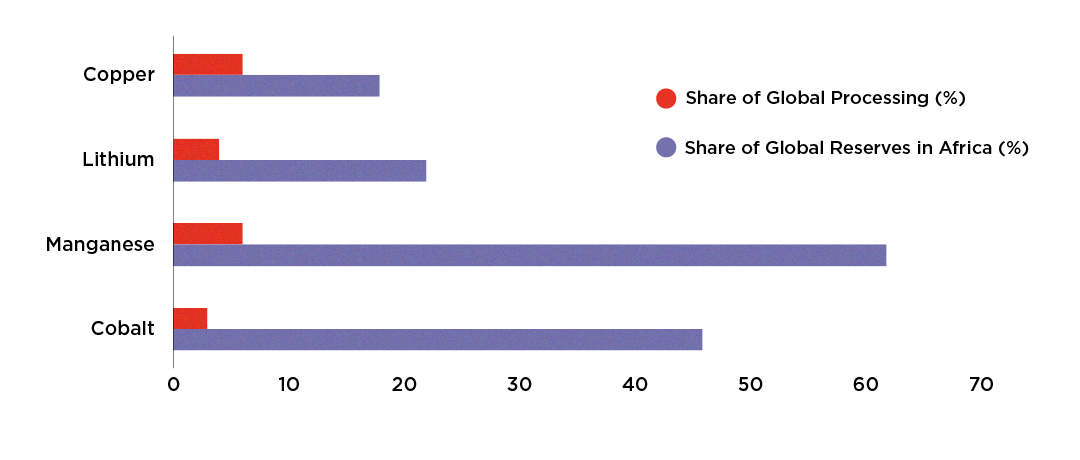
[Fig 1: Africa’s Share of Global Reserves vs Share of Global Processing (%) / Sources: USGS (2025); IEA (2024); PACT Africa (2025)]
A changed external environment
What has changed is the external context. Critical minerals now sit at the centre of industrial policy, national security planning and geopolitical competition. The United States Inflation Reduction Act links clean vehicle tax credit rules to critical minerals extracted or processed in the United States or in free trade agreement partner countries or recycled in North America. The European Union Critical Raw Materials Act sets 2030 benchmarks for the EU to reach at least 10 percent of annual consumption from extraction, 40 percent from processing and 25 percent from recycling, while also reducing over-dependence on any single third country. China has used export controls on materials such as gallium, germanium, graphite and rare earth-related products to demonstrate how powerful processing control can be.123
The world is not simply looking for minerals anymore. It is looking for secure supply, trusted jurisdictions, traceable products, resilient logistics and credible environmental standards. That shift creates opportunity for Africa, but it is a conditional opportunity. The premium is no longer attached to geology alone. It is attached to the ability to turn geology into an investable, reliable and responsibly processed product.
The ownership trap
The recent African record shows that governments are trying to correct old imbalances. The instinct is understandable. Many countries have watched minerals leave their soil for decades while the larger value was captured elsewhere. In that context, demands for better royalties, local equity, state participation, contract renegotiation and domestic processing are not irrational. They are a response to a history in which the bargain was often too thin for the country that carried the resource.
But there is a trap. Resource nationalism can change who captures the rent without changing what the economy is capable of producing. A government may seize an asset, renegotiate a licence or increase state equity, but none of those actions automatically builds a refinery, trains metallurgists, lowers power tariffs, secures water, finances tailings management, signs offtake agreements or creates a local supplier base. Political control and industrial capability are related, but they are not the same thing.
That distinction is visible across the continent. In Mali, Burkina Faso and Niger, transitional governments have renegotiated or revoked mining arrangements under nationalist mandates. The grievances behind those actions are often rooted in real public frustration. Yet the instrument is blunt. Forced renegotiation can redistribute extraction rents, but it can also raise investor risk and make it harder to attract the patient capital that processing requires. The difficult truth is that downstream industrialisation needs both sovereignty and credibility. Without sovereignty, the country captures too little. Without credibility, serious capital will not stay long enough to build.
Zimbabwe’s lithium lesson: processing can move, but the value chain may not
Zimbabwe offers one of the clearest current examples of both the promise and the risk of processing mandates. In February 2026, the government suspended exports of raw minerals and lithium concentrates, citing malpractices and leakages. Reuters reported that the ministry later set conditions for the resumption of lithium concentrate exports, including export quotas, a 10 percent export tax until a planned January 2027 concentrate ban, publication of annual financial statements, compliance with labour, safety and environmental standards, and written commitments to establish lithium sulphate plants before January 2027.4 5
The policy has produced a visible result. Huayou Cobalt announced in April 2026 the first export of lithium sulphate from its Zimbabwe operation. The product is not yet a finished battery chemical, but it is an intermediate step beyond raw concentrate. It shows that a processing mandate, when backed by pressure and existing investment, can move some value addition into the country. 6
The harder question is who controls the chain after that step. Chinese firms dominate Zimbabwe’s lithium mining sector, and the processed intermediate product still sits within a supply chain that largely points towards Chinese downstream manufacturers. For Zimbabwe, this is better than exporting only concentrate, but it may still fall short of structural transformation if the country remains dependent on foreign technology, foreign capital, foreign offtake and foreign industrial demand. The story is therefore not a simple success or failure. It is a warning that processing can move geographically without value-chain power moving politically or economically.
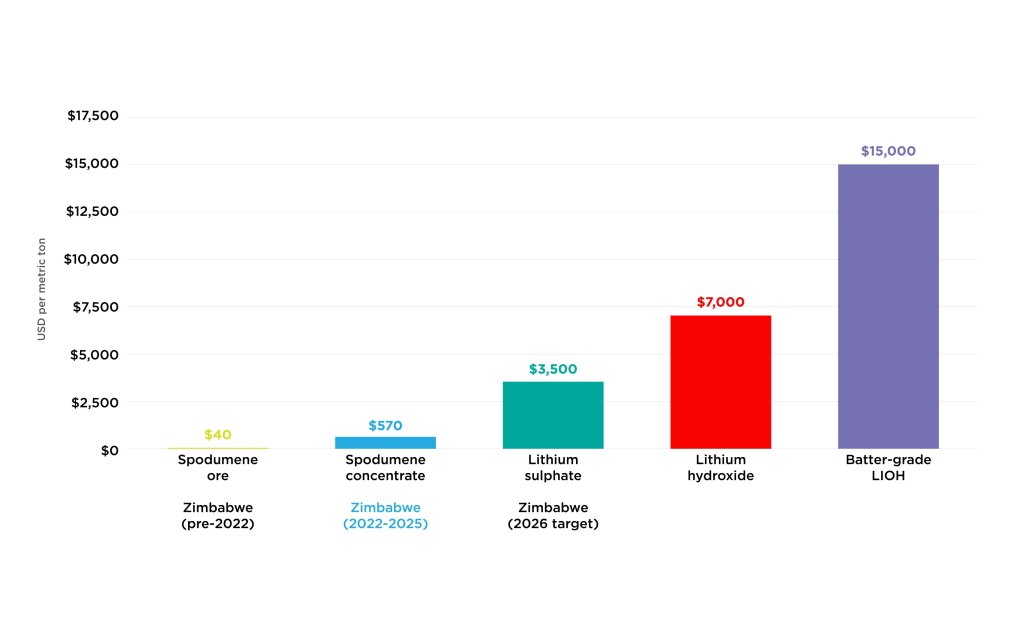
[Fig 2: the lithium value ladder and where Zimbabwe currently sits / Source: IEA Critical Minerals Market Review]
Botswana’s diamond warning: a better deal is not the same as a new economy
Botswana tells a different and equally important story. It is one of Africa’s strongest examples of mineral governance and long-term state capacity. Diamonds helped finance schools, roads, health services and public administration. That is why the current pressure on the diamond market feels larger than a commodity cycle. It touches the social contract. When a country has used one mineral to build national stability, disruption to that mineral is not only a market issue. It is a national planning issue.
In February 2025, Botswana and De Beers signed a long-delayed agreement that extended Debswana mining licences to 2054 and increased Botswana’s selling rights through the state-owned Okavango Diamond Company. Reuters reported that the agreement was reached after Botswana’s economy had contracted amid a prolonged downturn in the global diamond market. 7
This was a real commercial achievement. It improved Botswana’s position in the diamond value chain and gave the state greater access to rough diamond sales. But it did not by itself solve the industrial question. Selling a larger share of rough diamonds is still different from building a diversified manufacturing base. The pressure is sharpened by the rise of lab-grown diamonds. Industry data cited by the World Diamond Council reported that 45.3 percent of engagement rings sold in the United States in 2024 were set with lab-grown diamonds, while Rapaport reported that The Knot’s data showed lab-grown centre stones passed 50 percent in 2024. 8 9
The lesson from Botswana is not that the country failed. It is the opposite. Botswana shows that even good governance and better bargaining power are not enough when the underlying market changes. A better deal can buy time. It cannot replace the need to build new capabilities. For countries dependent on a narrow mineral base, the most important question may not be how to capture a larger share of today’s mineral rent, but how to use that rent before the market moves away.
Guinea’s Simandou programme: vision at scale, delivery still to prove
Guinea presents the most explicit articulation of the processing sovereignty argument currently underway on the continent. President Doumbouya’s stated position that minerals will no longer exit as raw assets but as industrialised national value chains is not merely political rhetoric. It is anchored in the Simandou 2040 Sustainable and Responsible Socio-Economic Development Programme, a fifteen-year framework comprising 122 projects and over $200 billion in planned investment, structured around infrastructure, industrialisation and human capital development. 10
The programme’s ambition is deliberately integrated. The Simandou corridor, over 650 kilometres of railway and new deep-water port capacity, is designed not only to move iron ore to market, but to anchor the logistics infrastructure on which processing industries depend. A target of approximately 4,000 MW of installed power capacity by 2030, combined with planned special economic zones along the corridor, reflects an understanding that the industrial zone is as important as the mine. Guinea has also established a Delivery Unit at the highest level of the state to coordinate execution, a governance mechanism that distinguishes the Simandou 2040 programme from the announcement-without-implementation cycle that has characterised beneficiation policy elsewhere.
Whether this translates into structural transformation will depend on execution. Guinea’s sovereign rating was upgraded by S&P to B+ with a positive outlook in March 2026, a signal of improved institutional credibility, but also a reminder of how recently that credibility was established. The investment environment remains early-stage, and approximately 40 percent of the programme’s financing is expected from the private sector – capital that will make its own assessment of regulatory stability, contract enforceability and the consistency between policy announcement and implementation. Guinea is, in this sense, the clearest current test of whether the processing sovereignty argument can be converted from political vision into industrial reality.
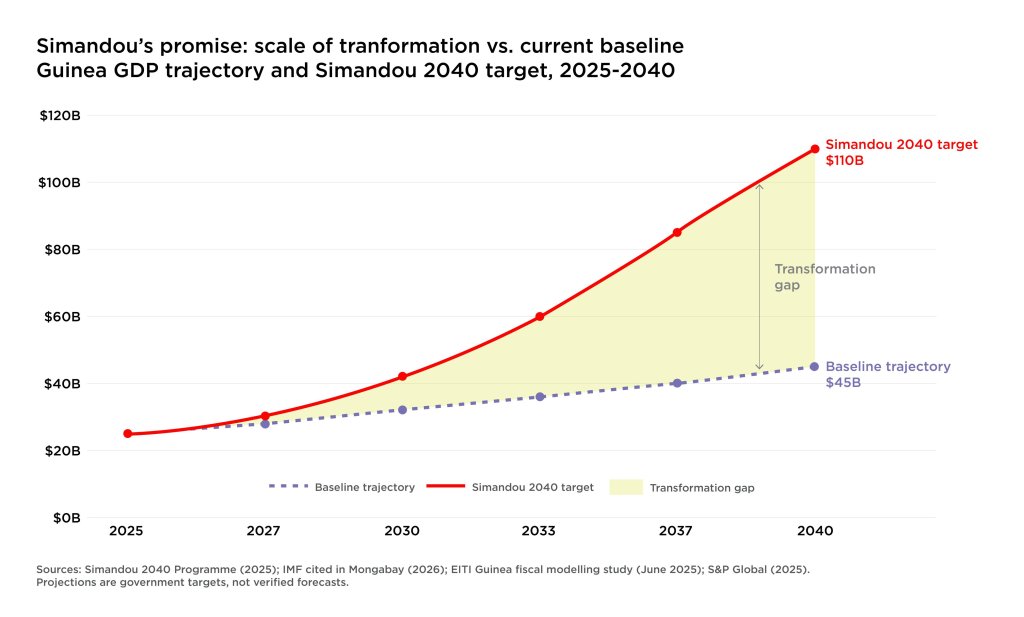
[Chart X: Simandous promise: scale of transformation vs current baseline / Simandou 2040 Programme (2025); IMF cited in Mongabay (2026); EITI Guinea fiscal modelling study (June 2025); S&P Global (2025). Projections are government targets, not verified forecasts]
What should mineral-rich countries actually sell
Governments often begin with the mineral, asking how much copper, cobalt, lithium or gold they have. That is necessary but not sufficient. The sharper question is what the country can sell in a way that customers will pay for, financiers will back, communities will accept and the economy can sustain.
The answer will not be the same for every mineral. Where domestic processing is uneconomic, because of energy, water, logistics or scale, selling ore or concentrate is not failure. It is discipline. Beneficiation becomes dangerous when treated as a blanket instruction rather than a commercial choice.
Where the economics are viable, countries should aim to sell more than concentrate: intermediate processed products, certified responsible supply, stable offtake platforms and the credibility that comes from transparent contracts. In battery minerals, that may mean moving from ore to lithium sulphate before attempting battery-grade chemicals. In copper and cobalt, it may mean linking extraction to refining through corridor and energy planning.
Countries should not try to sell the world a political slogan. They should sell an investable value chain, one that answers six questions before a minister signs a mandate or an investor signs a term sheet: Is the resource base sufficient? Is processing viable at local energy, water and logistics costs? Who buys the processed product? Who owns the licence, the plant and the offtake? What environmental obligations are enforceable? What capabilities remain in the country after the first shipment leaves?
A processing-first framework
The choice facing mineral-rich governments is not between resource nationalism and open-door investment. It is between two models of sovereignty: one that controls ownership, and one that builds capability. The first is easier to legislate. The second is the only one that produces structural transformation.
Processing sovereignty means the state uses licensing, infrastructure, environmental governance and investor conditionality to maximise domestic industrial capability, not ownership for its own sake. It requires one prior commitment: to know the value chain as precisely as the geology. A geological survey tells a country what is in the ground. A value-chain map tells it what is worth doing with it, at which processing stage, under what conditions, for which buyers, and with what capability left behind when the contract expires.
The framework operates across six dimensions:
| Dimension | What it requires |
| Mineral prioritisation | Classify minerals by processing viability, market demand and infrastructure readiness. Apply mandates only where the economics support them. |
| Licence design | Stage value-addition obligations to match real infrastructure timelines. Avoid sudden rules that strand committed investment. |
| Infrastructure sequencing | Secure reliable power, water and logistics before enforcing processing mandates. The industrial zone is as important as the mine. |
| Ownership transparency | Publish licences, contracts, beneficial ownership and fiscal terms. Hidden ownership deters serious capital. |
| Environmental pricing | Build impact assessments, tailings standards and rehabilitation bonds into licence conditions from day one, not after controversy. |
| Capability negotiation | Negotiate for skills transfer, local suppliers and technical training alongside equity. The know-how that remains is worth more than the shareholding. |
The framework does not prescribe universal processing. It prescribes universal rigour. Some minerals will not be worth processing domestically in the near term. Acknowledging that is not a concession, it is the analytical foundation on which viable processing strategy is built.
Conclusion: the mineral is only the beginning
The next mineral race will not be won by the countries with the loudest ownership claims. It will be won by the countries that can turn ownership into capability. That requires a harder kind of politics than nationalisation rhetoric. It requires disciplined choices, patient institution-building, credible contracts, environmental honesty and the humility to process only where processing makes economic sense.
There is a human reason to get this right. Behind every mine is a community that wants more than compensation. Behind every export figure is a worker who wants a skill that still matters after the pit closes. Behind every mineral agreement is a child whose school, road, clinic or future may depend on whether the country negotiated for a shipment or for an industry.
Africa’s endowment is already settled by geology. Its transformation is not. That will be decided in investment codes, mining agreements, power plans, environmental permits, industrial zones, training institutions and the courage to ask a better question. Not simply, “Who owns the mine?” but, “What will this mineral leave behind?”
Authors:

Sean Ong
Executive Vice President

Vyshnav Menon
Senior Associate
——-
Let’s transform together. Contact us at: https://pemandu.org/contact-us/
References:
[1] U.S. Department of the Treasury and IRS guidance on clean vehicle credits and critical mineral requirements under the Inflation Reduction Act, including rules relating to extraction or processing in the United States or free trade agreement partners, recycling in North America, and foreign entity of concern restrictions.
[2] European Commission, European Critical Raw Materials Act, including 2030 benchmarks for extraction, processing, recycling and reduced single-country dependency.
[3] Reuters reporting on China export controls on gallium, germanium, graphite and rare earth-related products between 2023 and 2025.
[4] Reuters, “Zimbabwe bans exports of all raw minerals and lithium concentrates, cites malpractices,” 25 February 2026.
[5] Reuters, “Zimbabwe to introduce lithium export quotas, sets conditions for resumption of shipments,” 8 April 2026.
[6] Reuters, “China’s Huayou reports first lithium salt exports from Zimbabwe,” 28 April 2026.
[7] Reuters, “Botswana, De Beers sign long-delayed diamonds deal,” 25 February 2025.
[8] World Diamond Council, “Nature versus nurture,” citing industry data on lab-grown diamonds in U.S. engagement rings in 2024.
[9] Rapaport, “Lab-Grown Taking Over Engagement-Ring Spending,” 19 February 2026, citing The Knot data that lab-grown centre stones passed 50 percent in 2024.
[10] Simandou 2040 Sustainable and Responsible Socio-Economic Development Programme (2025). Investment Brochure. Republic of Guinea: Simandou Strategic Committee. The programme targets GDP growth from approximately $25 billion in 2025 to over $110 billion by 2040, with more than 5 million additional jobs. Note: GDP figure reflects the rebasing exercise completed in October 2025