The way a nation moves reveals its priorities and the current energy crisis demands an honest response on what it means for Malaysia.
The Moment Has Arrived
When the Strait of Hormuz effectively closed in early 2026, and remained under heavy restriction thereafter, the consequences arrived without ceremony. Brent crude breached USD 100 a barrel. Across Southeast Asia, fuel queues formed, subsidies strained, and governments scrambled to release emergency reserves. The Philippines declared a national energy emergency. Myanmar restricted private vehicle use to alternate days. Indonesia, despite being an oil producer itself, found itself managing a 22-day fuel reserve with increasing anxiety. The International Energy Agency described it as the greatest global energy security challenge in modern history [1].
Malaysia, as both an oil and gas producer, was comparatively cushioned. The government moved quickly to maintain RON95 at RM1.99 per litre under the BUDI95 scheme, absorbing the cost differential as global prices surged [2]. It was the right call for the short term. But it also illuminated a deeper problem – Malaysia’s instinctive response to an energy shock is to protect the conditions that make car ownership the only viable option for most of its people.
This is the moment to ask a harder question — not how Malaysia weathers this energy shock, but whether the country is prepared to use it as the catalyst to rethink, fundamentally, how its people move, and what it would take to build a mobility ecosystem that is less exposed to the next one.
How Malaysia Got Here
The story of how Malaysia became one of the most car-dependent nations in Asia is a story of decisions that made sense in their time, whose cumulative weight is now a structural liability.
Post-independence development required mobility. Connecting peninsular towns, opening economic corridors, enabling a growing population to reach jobs, education, and markets. Private vehicle was the instrument of that access, and policy followed accordingly. Proton was established to make car ownership a national project, fuel subsidies kept running costs low and roads and highways absorbed the majority of infrastructure spending. The logic was coherent – a developing economy needed its people to move, and the car was the fastest way to enable that.
What was not built, in parallel, was a credible alternative. Public transport was never designed to compete with private vehicles; it was designed to serve those who could not afford one. Urban planning followed road infrastructure rather than shaping it. Residential development sprawled outward from city centres in patterns that made walking impractical and transit uneconomical to serve. Over decades, the built environment became structurally aligned with the private vehicle and hostile to everything else.
The numbers reflect this plainly. Malaysia has approximately 17.2 million registered cars and 16.8 million motorcycles [3]. In the Klang Valley, only around 20% of daily trips are made by public transport — compared with 57% in Singapore, 72% in Seoul, and 87% in Hong Kong [4]. In Kuala Lumpur, car ownership has been estimated at roughly two vehicles per person [5]. Transportation costs such as vehicle ownership, fuel, and maintenance, consume an estimated 20% to 30% of monthly household expenditure for Klang Valley residents [5]. This burden falls hardest on lower-income households. The World Bank’s 2024 report on inequality and mobility in Malaysia finds that fuel subsidies have historically benefited better-off households disproportionately, and that better-targeted reform could reduce inequality while generating fiscal savings [6].
The environmental cost is equally clear. Malaysia’s Low Carbon Mobility Blueprint 2021–2030 documents that the transport sector accounts for 20% of Malaysia’s total GHG emissions, with road transport alone responsible for 18%; the second-largest GHG-emitting sector in the country [7]. Transport is also the second-fastest growing energy consumer, driven almost entirely by private vehicle use. The Blueprint sets an explicit target of 40% public transport modal share which is a target Malaysia has aspired to for over a decade without achieving [7].
These numbers reflect a country that was designed around cars and an energy system left increasingly fragile by that design.
What the Research Tells Us About Why People Don’t Switch
One of the most instructive findings in recent Malaysian transport research is that the problem is not that Malaysians are unwilling to consider public transport in principle. It is that the system has never offered them a compelling enough reason to switch in practice.
A 2023 study by the Malaysian Institute of Road Safety Research (MIROS), examining willingness to shift among 512 road users across Peninsular Malaysia, found an average willingness-to-shift score of just 2.67 out of 10 [8]. The most commonly cited barriers were comfort and convenience of the private vehicle (38.8% of respondents) and dissatisfaction with the current public transport system (34.8%). Long travel times, family logistics and the perceived inflexibility of fixed schedules were also significant deterrents.
The same study reveals when specific improvements are introduced, willingness shifts dramatically. Regular and predictable public transport schedules produced the highest response (mean score of 6.76 out of 10), followed closely by a 20% reduction in fares (6.71) and increased park-and-ride parking at stations (6.69) [8]. This suggests Malaysians value reliability and predictability more than they value the car itself — qualities the current system does not consistently deliver.
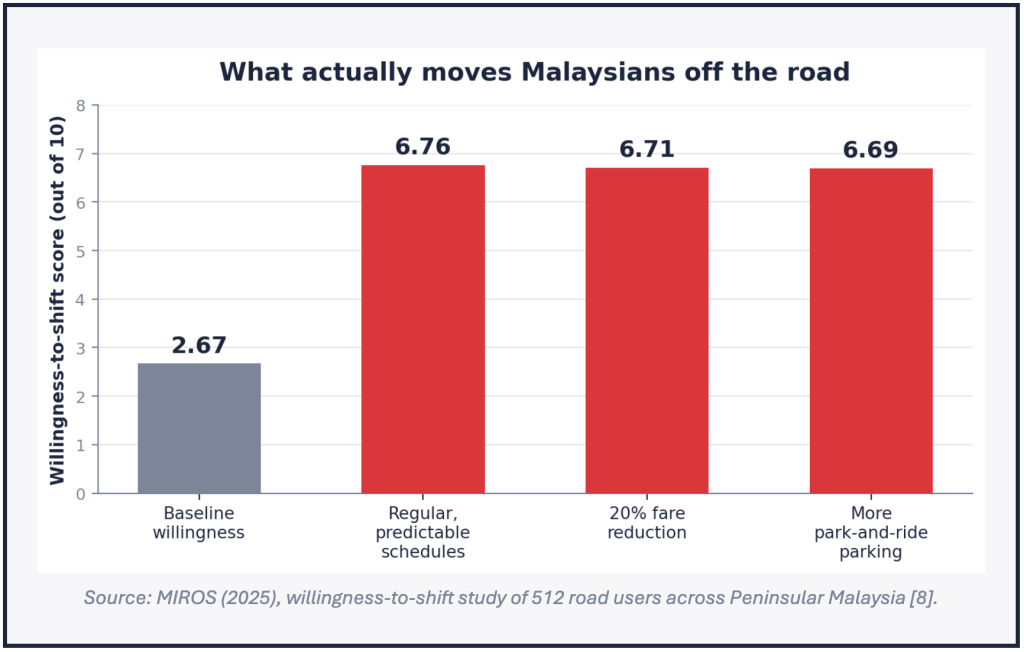
Importantly, “push” measures such as fuel price increases, toll hikes, and higher parking fees received significantly lower willingness scores, suggesting that financial disincentives alone will not shift behaviour if the alternative remains unpredictable and incomplete [8]. Mode shift requires pull measures — making public transport genuinely better — alongside demand-side incentives.
The MIROS research also surfaces a regional dimension that deserves sustained policy attention. The central region showed the highest willingness to shift (3.14 out of 10), while the northern (2.05) and eastern (2.19) regions showed the lowest [8]. This reflects infrastructure availability, not cultural attitudes. Where public transport does not exist as a credible option, willingness to use it is predictably low. This makes the case for network extension beyond the Klang Valley a behavioural argument as much as an infrastructure one.
What is Keeping People in Their Cars
Understanding why Malaysians continue to drive despite the cumulative costs comes down to system design, not attitude. As Wan Agyl Wan Hassan, founder of transport think tank MY Mobility Vision, has argued, Malaysia has largely delivered on infrastructure expansion, while key outcome indicators — public transport modal share, emissions, affordability — have stagnated or moved the wrong way [9]. Malaysia has built much of the hardware it needs; what it has not built is the system around that hardware. Public transport in Malaysia fails quietly at every seam, and those accumulated failures add up to a journey most rational commuters will not choose.
The last mile remains the first failure. Malaysia has spent more than RM120 billion building rail infrastructure in the Klang Valley, creating one of the most extensive urban rail systems in Southeast Asia [10]. Yet for thousands of commuters, the most stressful part of the journey is simply getting to the station. Feeder buses remain unreliable and infrequent, some arriving every 30 to 60 minutes, many delayed by the very congestion the rail system is supposed to alleviate [10]. The MRT Kajang and Putrajaya Lines, the three LRT corridors, KTM Komuter, and the LRT Shah Alam Line, which began operations at the end of June 2026 after multiple delays, collectively cover significant ground. The MRT3 Circle Line has received final approval, with construction expected from 2027. But a rail network is only as useful as the journey it completes, and that journey ends not at the station but at the destination. Research consistently identifies first- and last-mile connectivity as a decisive barrier: inconvenient or unsafe access to stations can undermine perceived accessibility and deter mode shift even when the main transit service itself is functional [8].
This points to a distinction the governance argument above does not fully make. Institutional reform and rail investment can deliver the trunk network and the intercity story — the ECRL corridor, the Klang Valley’s rail spine, a future Trans-Borneo line. They cannot retrofit density onto suburbs that have already been built the way Malaysia’s have. Four decades of car-first planning will not be undone by better feeder bus schedules, however well the schedules are governed.
For the Klang Valley’s existing low-density suburbs, then, the answer is not a smaller version of the trunk network. It is a different mode, treated as permanent rather than as a stopgap. Arlington, Texas — a city of 400,000 people that has had no fixed-route bus network since 1934 — replaced the idea of a bus route with citywide, on-demand microtransit, on the reasoning that no fixed schedule makes sense at that density regardless of how well it is run [23]. Innisfil, a similarly sprawled town in Ontario, calculated that a single bus route would serve roughly a fifth of residents at a cost the town could not justify, and instead subsidises on-demand ride-hailing as its public transit system [24]. Malaysia already has an equivalent in Kumpool’s on-demand shuttle model; the open question is whether it becomes a permanent layer of national transport policy or remains a pilot.
This changes what a mobility commission should be asked to build. Along new corridors — Kuantan, Kota Kinabalu, the ECRL stations — its job is to shape density around rail as it is laid down. In the Klang Valley’s existing suburbs, its job is to commission flexible, on-demand transit as the permanent first- and last-mile layer for a geography that is not going to change, rather than waiting for fixed routes to eventually catch up.
Reliability is a prerequisite. A commuter who has been stranded twice does not merely complain — they revert to the car, often permanently. The MIROS study found that regular and predictable schedules were the single most powerful intervention for improving willingness to shift [8]. People will accept a longer journey if it is dependable, but not a shorter one that carries genuine uncertainty. Addressing reliability is an operational and governance challenge more than a capital one, which means it can be fixed faster than a new rail line is built, if institutional will exists.
Walkability is infrastructure. For decades, Malaysia has been trapped in car-centric urban planning, turning cities into sprawling, traffic-clogged landscapes where pedestrians are overlooked and cyclists are nearly invisible [11]. As one commentator has put it, walking is treated in Malaysian policy as a beautification project – the responsibility of local councils, something for tourists in Bukit Bintang — rather than as a national economic strategy or a key pillar of mobility [12]. Singapore’s underground pedestrian networks connect major transit hubs and commercial zones, making the walk between modes feasible regardless of weather. Tokyo’s neighbourhood design ensures that daily needs are walkable from transit stations, with continuous, shaded footpaths as a baseline expectation. Malaysia’s Low Carbon Mobility Blueprint explicitly identifies the promotion of active and micro-mobility (walking and cycling as one of its ten core strategies for GHG and energy reduction) [7]. Walkability is embedded in the decarbonisation agenda, and yet it remains chronically underfunded.
Integration is the missing governance layer. One agency expands highways while another tries to increase public transport ridership. One authority approves sprawling developments while another talks about sustainability. Local councils neglect pavements, cycle paths, and pedestrian crossings. The result is a country where driving becomes the only practical option, even for short trips [13]. Seoul’s T-money card and Tokyo’s Suica have made the multi-modal journey — plan once, pay once, travel across every mode — the default experience for decades. In the Klang Valley, the handoff between rail, bus, and e-hailing remains fragmented. Different payment systems, different apps, no single view of the complete journey. The Low Carbon Mobility Blueprint identifies Mobility as a Service (MaaS) as one of the key areas for green technology mainstreaming [7]. The concept exists in policy. The delivery remains some distance away.
The Governance Gap at the Centre of It All
Underlying all four gaps is a more fundamental problem: Malaysia’s transport system is institutionally leaderless.
When SPAD was abolished in 2018, its functions were distributed across APAD, Prasarana, local councils, and PLANMalaysia. Today, when an MRT station lacks a walkway, everyone blames someone else. No single body is accountable for the complete journey [14]. The government’s own National Transport Policy 2019–2030 and Kuala Lumpur Structure Plan 2040 promise a shift toward public transport and active mobility — better buses, safer walking and cycling, transit-oriented development. However, without a unified institution to plan, regulate, and enforce across all modes, these commitments remain difficult to deliver coherently [15].
The case for a dedicated mobility commission — a Suruhanjaya Mobiliti Malaysia — has been gaining traction in policy circles. Rather than reinstating SPAD as it was, what is needed is a new institution for a new era: one that plans, regulates, and is accountable for all forms of movement including trains, buses, walking, cycling, and micro-mobility, with mode-share targets, safety benchmarks, and equity indicators as its core performance framework [14]. Its goal should be clear – to lift public and active transport modal share to at least 40% the target Malaysia has been missing for a generation [7].
Where Singapore’s Land Transport Authority made the city-state move efficiently, Malaysia’s equivalent could be designed to make it move fairly with direct planning powers, local representation, and a mission centred on equity and access, not just throughput [14]. Budget 2026 allocated over RM12 billion for transport and road-related projects, with Prime Minister Anwar Ibrahim describing mobility as “the lifeblood of the economy and the people’s livelihoods” [16].
The Pipeline That Cannot Be Wasted
Malaysia is not standing still on transport infrastructure. A significant pipeline of rail investment is either under construction or in active planning and this represents both a genuine opportunity and a serious obligation to get the ecosystem right around these assets.
The ECRL is the most immediate and substantial. The 665-kilometre line connecting Kota Bharu to Gombak, and eventually Port Klang, has reached over 90% construction and operations expected to begin in January 2027 [17]. It will reduce travel time from Kota Bharu to KL from seven hours by road to approximately four hours by rail, connecting the East Coast states of Kelantan, Terengganu, and Pahang to the Klang Valley for the first time by rail. Thailand has indicated interest in extending the line to the Sungai Golok border under Pan-Asia Railway Network aspirations [18]. Its potential as an economic equaliser for historically underserved East Coast communities is real but its value will be determined by what is built around its stations, not just along the tracks. These stations are opportunities for transit-oriented development that, if not deliberately seized through land use planning and first-and-last-mile investment, will yield underutilised assets in areas that remain car-dependent by design.
In the Klang Valley, the Kita Selangor Rail positions itself as the missing link in the state’s connectivity picture. Described by the Selangor MB as “the final piece of the puzzle that would connect industry, people, and major transport infrastructure in Selangor and the Klang Valley” [19], the proposed 200-kilometre network which is currently in feasibility study, would run from Labu in Negeri Sembilan northward through Shah Alam, Klang, and up the Selangor coast to Sabak Bernam, connecting Port Klang, KLIA, and Sultan Abdul Aziz Shah Airport in Subang with planned integration points with the ECRL [20]. It is a ten-year commitment minimum, with financing and phasing still to be resolved.
In Penang, construction of the 29-kilometre Mutiara Line LRT is confirmed. It is targeted for completion in December 2031 and represents the island state’s first rail transit system — a structural shift in how Penang manages its growing mobility pressure. Budget 2026 confirmed that construction of the Mutiara Line has commenced, expected to benefit 1.8 million residents and 3.5 million tourists annually [16].
In Borneo, a 12-month feasibility study for the Trans-Borneo Railway linking Sabah, Sarawak, Brunei, and Kalimantan, funded at RM7 million under the 12th Malaysia Plan began in June 2025, with results expected by the third quarter of 2026 [21]. If implemented, this would be among Southeast Asia’s most ambitious cross-border infrastructure projects, transforming East Malaysia from a region connected almost entirely by road and air to one with a rail backbone spanning the island of Borneo.
The Gemas–Johor Bahru electrified double track, completed and handed to the government in December 2025, has strengthened the southern rail spine. Johor is pressing for federal approval of a domestic rail system ahead of the JB-Singapore Rapid Transit System link opening in 2027, a 4-kilometre shuttle designed to carry up to 10,000 passengers per hour, which will funnel significant volumes into Bukit Chagar station that road infrastructure alone cannot absorb [18].
To support Malaysia’s low-carbon mobility goals alongside this rail expansion, Budget 2026 committed to 300 Demand Responsive Transit vans for first- and last-mile access, and 1,450 electric buses to be procured in phases until 2030 [16]. The MY50 travel pass, which recorded 2.6 million sales and helped users save up to 67% on monthly travel costs, shows that demand-side incentives for public transport do work when the offer is compelling [22].
This pipeline is impressive in its ambition but has to be connected into a system that serves the complete journey.
The Transformation Malaysia Can Choose
Twenty years from now, Malaysia’s cities will be home to significantly more people, more economic activity, and more daily journeys than they manage today. The question is what system those journeys will move through.
One version of that future is a scaled-up version of the present: more vehicles on wider roads, somewhat electrified, served by a rail network that has grown but remains underutilised because the ecosystem around it was never properly addressed. Congestion remains the tax on daily life. Household transport costs remain a persistent drain on B40 and M40 families. The option to live without a car remains unavailable to most.
Another version looks genuinely different. The energy crisis of 2026 proves to be the inflection point when Malaysia chose to act on a systemic vulnerability rather than simply absorb it. The ECRL’s twenty stations become anchors of walkable, mixed-use development. The Kita Selangor Rail, the Penang Mutiara Line, and the MRT3 Circle Line are built not just as assets but as systems, with last-mile connections, reliable feeders, and integrated ticketing designed alongside the tracks. An empowered, centralised mobility agency gives the transport system someone accountable for the whole journey. The Trans-Borneo Railway feasibility study leads to implementation, giving Sabahans and Sarawakians a surface transport option that no generation before them has had. Over two decades, the Klang Valley’s public transport modal share moves meaningfully toward the 40% target that has been aspirational for a generation and that Malaysia’s own Blueprint has already enshrined [7].
The measure of success in that second future is concrete and human: a middle-income family in Petaling Jaya makes an unforced, practical choice not to own a second car. Not because they cannot afford one but because, finally, they do not need one. A commuter in Kuantan boards the ECRL to KL and arrives confident the journey will take four hours and that the last kilometre will work as well as the first. A young professional in Kota Kinabalu travels between Sabah and Sarawak by rail for the first time in history.
These outcomes are not guaranteed by the infrastructure being built. They become possible only if decisions about governance, land use, reliability, and integration are made alongside the construction.
Malaysia has built hard things before. Building a mobility system that genuinely serves its people rather than merely providing infrastructure for their vehicles is the next one worth committing to.
That work begins now.
Author:

Atiqah Shazlin
Senior Manager
——-
Let’s transform together. Contact us at: https://pemandu.org/contact-us/
References
[1] Wikipedia. (2026). 2026 Iran war fuel crisis. https://en.wikipedia.org/wiki/2026_Iran_war_fuel_crisis
[2] Ministry of Finance Malaysia. (2026, March 11). Govt Maintains Targeted Fuel Subsidies, RON95 Remains At RM1.99 Per Litre. Bernama. https://www.mof.gov.my/portal/en/news/press-citations/govt-maintains-targeted-fuel-subsidies-ron95-remains-at-rm1-99-per-litre-mof
[3] ISEAS–Yusof Ishak Institute. (2025). Economics and Politics of Malaysia’s Petrol Subsidy Reform (ISEAS Perspective 2025/68). https://www.iseas.edu.sg/wp-content/uploads/2025/08/ISEAS_Perspective_2025_68.pdf
[4] SC-Abeam. (2020). Comparisons of Cities’ Transportation Modal Shares and Post-Coronavirus Prospects. https://www.sc-abeam.com/and_mobility/en/article/20201203-01/
[5] The Centre. (n.d.). Getting Around: Towards a Decent Daily Commute. https://www.centre.my/post/getting-around-towards-decent-daily-commute
[6] World Bank. (2024). A Fresh Take on Reducing Inequality and Enhancing Mobility in Malaysia. Washington, DC: World Bank. https://www.worldbank.org
[7] Ministry of Environment and Water Malaysia (KASA). (2021). Low Carbon Mobility Blueprint 2021–2030: Decarbonizing Land Transportation. Putrajaya: KASA. http://mgtc.gov.my/storage/2021/11/Low-Carbon-Mobility-Blueprint-2021-2030.pdf
[8] Shabadin, A., Mohamed Jamil, H., Nemmang, M. S., & Ishak, S. Z. (2025). Towards Sustainable Mobility: Willingness to shift to public transport in Peninsular Malaysia. Environment-Behaviour Proceedings Journal, 10(SI41), 115–121. https://doi.org/10.21834/e-bpj.v10iSI41.7737
[9] Wan Agyl Wan Hassan. (2025, December 17). It’s an unfinished system, not infrastructure, that fails Malaysian commuters. Free Malaysia Today. https://www.freemalaysiatoday.com/category/opinion/2025/12/17/its-an-unfinished-system-not-infrastructure-that-fails-malaysian-commuters
[10] Wan Agyl Wan Hassan. (2025, December 6). When transport policies are a walking contradiction. Free Malaysia Today. https://www.freemalaysiatoday.com/category/opinion/2025/12/06/when-transport-policies-are-a-walking-contradiction
[11] Free Malaysia Today. (2025, March 27). How to get Malaysians walking and cycling. https://www.freemalaysiatoday.com/category/opinion/2025/03/27/how-to-get-malaysians-walking-and-cycling
[12] Free Malaysia Today. (2025, November 27). Walking — the RM300bil answer Malaysia keeps ignoring. https://www.freemalaysiatoday.com/category/opinion/2025/11/27/walking-the-rm300bil-answer-malaysia-keeps-ignoring
[13] Boo Jia Cher. (2026, May 13). To beat the fuel problem, free people from having to drive everywhere. Free Malaysia Today. https://www.freemalaysiatoday.com/category/opinion/2026/05/13/to-beat-the-fuel-problem-free-people-from-having-to-drive-everywhere
[14] Boo Jia Cher. (2025, October 15). Malaysia needs a mobility commission, not just another transport agency. Free Malaysia Today. https://www.freemalaysiatoday.com/category/opinion/2025/10/15/malaysia-needs-a-mobility-commission-not-just-another-transport-agency
[15] Free Malaysia Today. (2025, November 15). The NPE2: Yet another billion-ringgit mistake. https://www.freemalaysiatoday.com/category/opinion/2025/11/15/the-npe-2-yet-another-billion-ringgit-mistake
[16] The Malaysian Reserve. (2025, October 10). Malaysia expands public mobility, rail connectivity with RM8.1b for road safety, low-carbon transport. https://themalaysianreserve.com/2025/10/10/malaysia-expands-public-mobility-rail-connectivity-with-rm8-1b-for-road-safety-low-carbon-transport
[17] Malay Mail. (2026, February 11). ECRL project moves into operations prep after hitting 91.7% construction progress, says Anthony Loke. https://www.malaymail.com/news/malaysia/2026/02/11/ecrl-project-moves-into-operations-prep-after-hitting-917pc-construction-progress-says-anthony-loke/208864
[18] Bernama. (2025, December 21). Key Rail Infrastructure Projects Advance Across Malaysia In 2025. https://www.bernama.com/en/news.php/?id=2504974
[19] Selangor Journal. (2025, June 5). Kita Selangor Rail final piece of Klang Valley transport puzzle, says MB. https://selangorjournal.my/2025/06/kita-selangor-rail-final-piece-of-klang-valley-transport-puzzle-says-mb/
[20] Selangor Journal. (2025, July 10). Kita Selangor Rail feasibility study underway, state assembly hears. https://selangorjournal.my/2025/07/kita-selangor-rail-feasibility-study-underway-state-assembly-hears/
[21] The Edge Malaysia. (2025, August 14). Trans-Borneo Railway feasibility study to conclude by 3Q2026 — Loke. https://theedgemalaysia.com/node/766494
[22] The Star. (2026, January 6). Transport Ministry committed to strengthening sustainable mobility, service quality by 2026. https://www.thestar.com.my/news/nation/2026/01/06/transport-ministry-committed-to-strengthening-sustainable-mobility-service-quality-by-2026
[23] Government Technology. (2021, May 4). Arlington, Texas, Expands On-Demand Micro-Transit Citywide. https://www.govtech.com/fs/arlington-texas-expands-on-demand-micro-transit-citywide.html
[24] Municipal World. (2018, April 23). Innisfil, Ontario earns international recognition for its transit initiative, powered by Uber. https://www.municipalworld.com/feature-story/innisfil-ontario-earns-international-recognition-transit-initiative-powered-uber/