This piece is published as part of PEMANDU Associates’ thought leadership series. The views expressed are the author’s own, presented to contribute to public policy discourse, and do not constitute the institutional position of PEMANDU Associates or any of its clients.
—
On 2 October 2026, Formula 1 returns to Sepang for the first time in nine years. Malaysia stepped in at short notice to host Bahrain’s round after regional conflict in the Middle East disrupted the calendar. Made possible by the strong government-to-government relationship between Malaysia and Bahrain, it is a timely example of what trusted partnerships can achieve when both sides are committed to getting it done, and done well.
The return is worth celebrating, and it also opens an opportunity that reaches well beyond the chequered flag.
Between 1999 and 2017, Sepang International Circuit (SIC) hosted eighteen consecutive Malaysian Grands Prix. By the time Malaysia stepped away, the economic case had become increasingly difficult to sustain. The hosting fee was becoming harder to justify against the returns the race was generating. That is not an argument against F1. It is an argument for doing it differently.
Under specific conditions, with deliberate policy choices, the event can catalyse a broader economic programme that lasts well beyond the race weekend. The difference between those two outcomes is not the race. It is everything built around it.
The sport Malaysia parted from is not the sport it is returning to
When Malaysia left the F1 calendar in 2017, the sport was at a viewership low with an average of 352 million global viewers, down from a peak of 600 million in 2008. The business case for paying RM300 million annually in hosting fees was genuinely difficult to make and the government made the rational decision to exit the sporting circuit from 2018 onwards.
Since then, F1 has transformed itself. Under Liberty Media’s ownership, F1 rebuilt its commercial model with a digital-first approach, targeting younger audience and new markets. By 2025, F1’s global viewership had reached 827 million. The sport’s fanbase exceeded 830 million people, with 64 percent growth since 2018. Malaysia now returns to a sport whose audience has more than doubled since it last raced at Sepang.
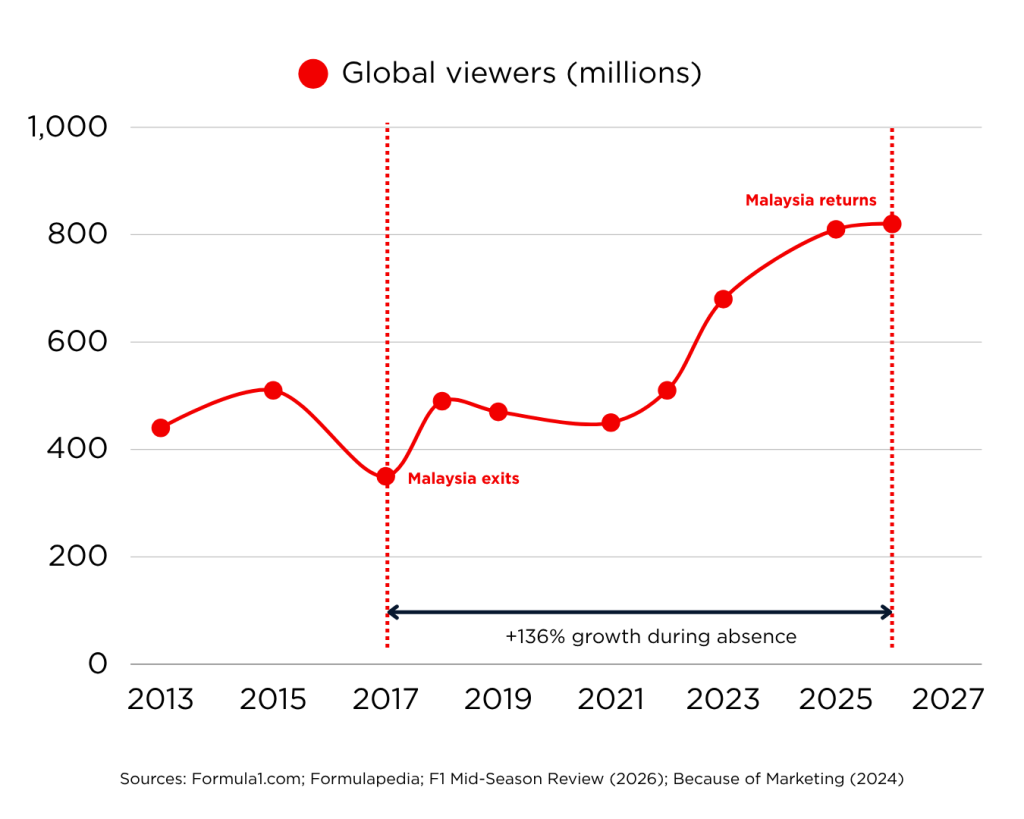
Figure 1: F1 global viewership, 2013-2026
The calendar has expanded to match, between 2017 and 2026 F1 added Miami, Las Vegas, Jeddah, Qatar and Madrid with Bangkok on the cards for 2028. Each addition represents a government that made an active decision to invest into the sport as Malaysia decided to step away.
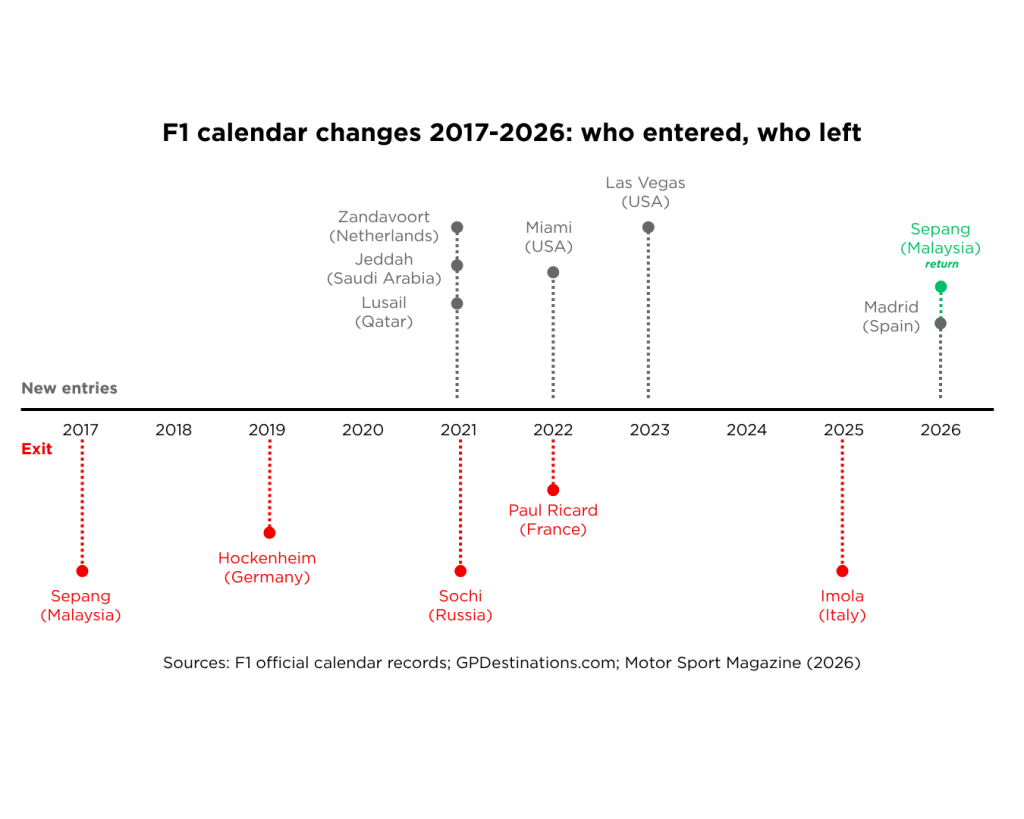
Figure 2: F1 calendar changes 2017-2026
Few circuits return to the calendar once they leave. Sepang’s selection as a short-notice host places it alongside circuits such as Imola and Istanbul, which F1 brought back during the disrupted 2020 season, and reflects confidence in its infrastructure and organising team.
Why Malaysia left and what the cost structure reveals
The Sepang Grand Prix was dropped from the calendar in 2017 following declining spectator numbers and a hosting fee structure that had become untenable. Sports minister Hannah Yeoh confirmed in 2025 that returning to F1 would cost RM300 million annually, covering hosting rights estimated at US$70 – 80 million, plus local preparation costs. A three-to-five-year contract commitment would amount to RM1.5 billion. The government ruled it out as unaffordable.
The 2026 arrangement is categorically different because Malaysia is hosting Bahrain’s race, rather than its own, the hosting fee has been waived. Bahrain covered those costs. Malaysia’s expenditure is the RM16 million it allocates annually for Sepang’s maintenance. The Prime Minister described it accurately: Malaysia is effectively hosting for free.
Malaysia’s head start
Malaysia is not starting from zero. PETRONAS has been a title partner of the Mercedes-AMG Petronas Formula One Team since 2010 – one of the most sustained and visible corporate partnerships in global motorsport. Sepang is purpose-built world-class circuit infrastructure, designed to Hermann Tilke’s specification and part of a broader Klang Valley development programme that also produced KLIA. The automotive and manufacturing cluster in the Klang Valley has genuine technical depth. The tourism and hospitality sector is mature and internationally competitive.
These are the ingredients of a recipe, and October 2026 is a chance to showcase it. A MIER study in 2025 estimated that a revived Grand Prix could contribute RM1.2 billion to the national economy over five years, but only under specific conditions, including accessible ticket pricing, broad local subcontracting, and a sustained economic programme around the race. Those conditions do not arise automatically from the race being held.
Interest across Southeast Asia underlines the value of an F1 slot in the region. Singapore is contracted until at least 2028, Thailand has approved a US$1.2 billion bid for a Bangkok street race from 2028, and Indonesia is in discussions with Liberty Media. Sepang enters that conversation with an advantage newer bids cannot match: a proven, purpose-built circuit and an organising team that has run world championship events for more than two decades.
The recipe
Hosts that have made F1 work economically point to a consistent set of conditions, in which the race is integrated into the wider economy.
| Ingredient | Where Malaysia Can Build |
| Turning Fans Into Local Spend | MOTAC estimates 50,000 international tourists will attend the F1 at Sepang, spending on hotels, flights, taxis, restaurants, shopping, entertainment, and trips around Malaysia. |
| Turn race week into destination week | Even F1 drivers have leveraged the event to enhance their overall Malaysian experience, turning their race attendance into extended visits, increased visitor spending, and economic benefits beyond the circuit. |
| Build the local skills pipeline | Use the event to develop capabilities in event logistics, hospitality and technical operations. |
| Measurable economic impact | Reporting the economic impact of the 2026 weekend would build the evidence base for a longer-term commitment. |
| Layer Business on Top of Tourism | Leverage the concentration of global brands, executives, and decision-makers around F1 to transform race week into a platform for business and commercial activity. |
The race is three days. The opportunity is longer.
Malaysia has an F1 race back at Sepang, even if only for one weekend, as we step in to help Bahrain deliver its Grand Prix. It is an unusual opportunity, and perhaps one worth simply making the most of. For now, this is one race, one weekend, and a chance to remind ourselves of what Sepang can still mean to global motorsport.
Perhaps it is the F1 enthusiast in me, but I hope this weekend does more than bring the sound of Formula 1 back to Sepang. I hope it reignites interest in Malaysian motorsport, brings a new generation into the sport, and starts a conversation about what could come next. There is no need to get ahead of ourselves. But if October 2026 becomes the weekend that Malaysia begins to dream about Formula 1 again, that would be a pretty good place to start.ther than a trophy on a shelf. Singapore took sixteen years and S$2.2 billion in tourism receipts to reach that conclusion. Malaysia can reach it faster, because the evidence is already there.
Author:

Vyshnav Menon
Senior Associate
——-
Let’s transform together. Contact us at: https://pemandu.org/contact-us/
Sources
- F1 viewership data: Formulapedia; F1 Mid-Season Review 2026; Because of Marketing (2024). Peak 2008 figure: 600 million. 2017 low: 352 million. 2025/2026 figure: 827–830 million
- F1 calendar additions and exits: F1 official calendar records; GPDestinations.com; Motor Sport Magazine (2026); F1mix.com circuit database.
- Malaysia hosting cost: BlackBook Motorsport (August 2025), citing Sports Minister Hannah Yeoh. RM300 million annually; RM1.5 billion over three-to-five-year contract commitment.
- Malaysia 2026 arrangement: FMT (July 2026); BFM News (July 2026), citing PM Anwar Ibrahim. RM16 million preparation cost; hosting fee waived by Bahrain.
- Singapore F1 economic data: Singapore Ministry of Trade and Industry written parliamentary reply (October 2025); SCMP (2025).
- Austin COTA economic impact: Host City News; COTA data cited in BUEA (2024). $2.8 billion cumulative 2012–2015; ~$900 million single race 2023.
- India and Korea losses: BUEA (2024). India 2013: ~$24 million loss. Korea 2012: ~$37 million loss. Both subsequently removed from calendar.
- MIER study: Malaysian Institute of Economic Research (2025). Projected RM1.2 billion economic contribution over five years, conditional on accessible pricing and broad local participation. Cited in ROCKSTARmedia (July 2026).
- Bangkok bid: SportsPro (August 2025); Planet F1. Thai government approved $1.2 billion plan for Bangkok street race from 2028.
- Sepang CEO on permanent hosting: The Edge Malaysia (July 2026), citing Azhan Shafriman Hanif. RM300 million annual cost; projected three-times return.