What separates economic transformation from an expensive race weekend
On 2 October 2026, Formula 1 returns to Sepang for the first time in nine years. The occasion is unusual. Malaysia is not hosting its own race. It is stepping in for Bahrain, whose Grand Prix schedule had been impacted following regional conflict in the Middle East. The hosting fee has been waived. Malaysia is, in the Prime Minister’s own words, getting in for free.
That should prompt a harder question than the one currently being asked: not whether to celebrate the return, but what Malaysia plans to do with it?
Between 1999 and 2017, Sepang International Circuit (SIC) hosted eighteen consecutive Malaysian Grands Prix. When it left, the economics did not add up. The hosting fee was not justified by what the race was delivering. That is not an argument against F1. It is an argument for doing it differently.
Under specific conditions, with deliberate policy choices, the event can catalyse a broader economic programme that lasts well beyond the race weekend. The difference between those two outcomes is not the race. It is everything built around it.
The sport Malaysia parted from is not the sport it is returning to
When Malaysia left the F1 calendar in 2017, the sport was at a viewership low with an average of 352 million global viewers, down from a peak of 600 million in 2008. The business case for paying RM300 million annually in hosting fees was genuinely difficult to make and the government made the rational decision to exit the sporting circuit from 2018 onwards.
What that decision did not account for was what happened next. Under Liberty Media’s ownership, F1 rebuilt its commercial model with a digital-first approach, targeting younger audience and new markets. By 2025, F1’s global viewership had reached 827 million. The sport’s fanbase exceeded 830 million people, with 64 percent growth since 2018. Malaysia was absent for the entirety of that transformation.
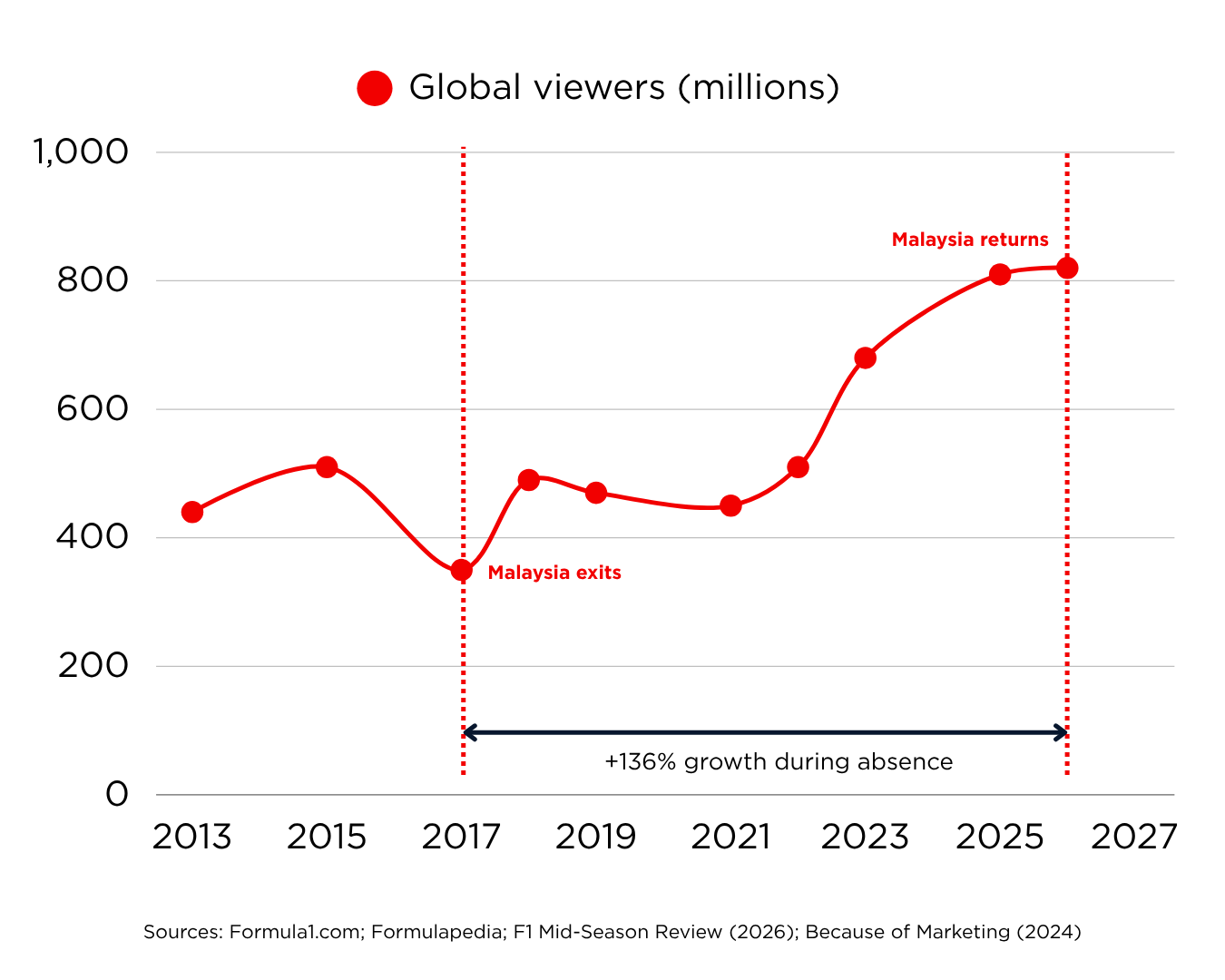
Figure 1: F1 global viewership, 2013-2026
The calendar has expanded to match, between 2017 and 2026 F1 added Miami, Las Vegas, Jeddah, Qatar and Madrid with Bangkok on the cards for 2028. Each addition represents a government that made an active decision to invest into the sport as Malaysia decided to step away.
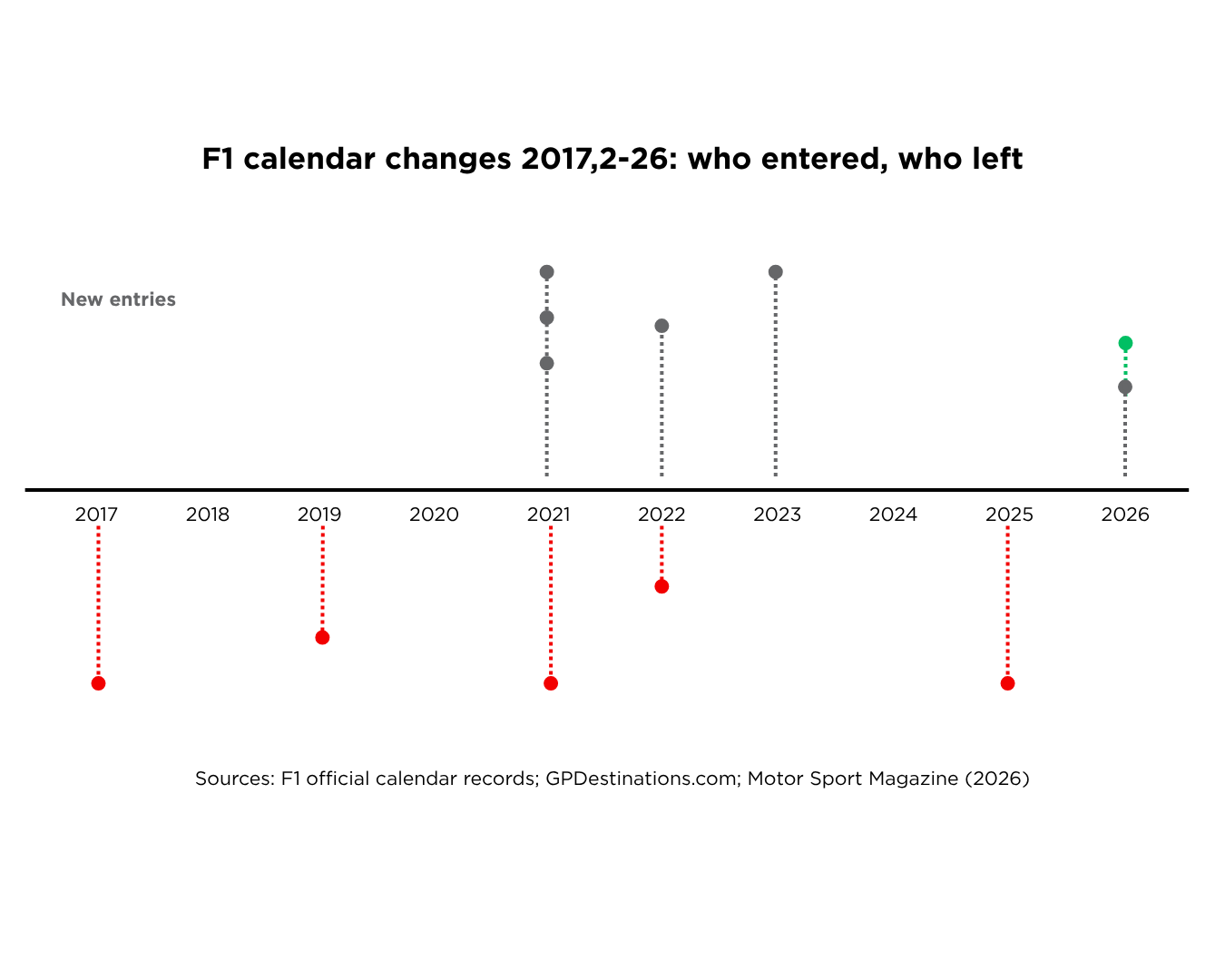
Figure 2: F1 calendar changes 2017-2026
Aside from France and Russia, both of which left for commercial and political reasons, India and Korea exited the calendar after failing to make the economics work, Malaysia sits in that statistical category. The 2026 return is an opportunity to change that.
Why Malaysia left and what the cost structure reveals
The Sepang Grand Prix was dropped from the calendar in 2017 following declining spectator numbers and a hosting fee structure that had become untenable. Sports minister Hannah Yeoh confirmed in 2025 that returning to F1 would cost RM300 million annually, covering hosting rights estimated at US$70 – 80 million, plus local preparation costs. A three-to-five-year contract commitment would amount to RM1.5 billion. The government ruled it out as unaffordable.
The 2026 arrangement is categorically different because Malaysia is hosting Bahrain’s race, rather than its own, the hosting fee has been waived. Bahrain covered those costs. Malaysia’s expenditure is the RM16 million it allocates annually for Sepang’s maintenance. The Prime Minister described it accurately: Malaysia is effectively hosting for free.
In a recent statement, SIC CEO Azhan Shafriman Hanif said, “most host countries generate returns of at least three times the amount they spend. If we spend RM300 million, the potential return could reach RM1 billion.” That three-times return projection is plausible, but it is a projection, not a guarantee. It depends entirely on whether the economic activity generated by the race is captured domestically, distributed broadly, and built into something that lasts. The international evidence on this is more mixed than the projection implies.
When it works: the Singapore benchmark
Since hosting its first Grand Prix in 2008, Singapore has attracted more than 720,000 international visitors and generated over S$2.2 billion in incremental tourism receipts. Annual hosting costs run at S$135–140 million, with the government co-funding up to 60 percent. On a headline basis the race barely breaks even. That framing misses the point.
Singapore’s economic return from F1 is not concentrated in the race weekend. It is distributed across the economy through a deliberate architecture built around the event. More than 700 Singapore-based companies are subcontracted annually to deliver the race. SMEs account for approximately 80 percent of race organisation work. Estimates suggest 80 to 90 percent of hosting costs are recycled into the local economy. The race has been extended into a ten-day Grand Prix Season Singapore, drawing business leaders, trade forums and conferences alongside the sport. The race is not what Singapore sold. It sold the surrounding programme.

Figure 3: SME and retail sales uplift during race weekend
The sector uplift data makes the distribution point concrete. Grocery retail up 120 percent. Restaurants and cafes up 80 percent. SME traveller-related sales up 65 percent. The race weekend does not benefit only luxury hotels and premium hospitality. When the surrounding programme is built deliberately, the economic pulse reaches every layer of the local marketplace. That is not an accident of geography or scale. It is the result of policy choices, local subcontracting mandates, extended event programming, skills pipelines built through institutional partnerships.
Austin, Texas reinforces the point from a different market context. The Circuit of the Americas generated $2.8 billion in cumulative economic impact to the Austin metro area between 2012 and 2015. A single race weekend in 2023 drew 450,000 spectators and generated approximately $900 million in local economic benefit. The infrastructure and hospitality ecosystem built to absorb that demand was the product of years of deliberate investment, not the race weekend itself.
When it fails: the cases that did not work
The counterexamples are equally instructive. India hosted its Grand Prix at the Buddh International Circuit in 2011, 2012 and 2013. The 2013 race lost approximately $24 million. The circuit had no surrounding economic programme, limited local subcontracting, and a ticket pricing structure that excluded most of the domestic population. India left the calendar and has not returned. Korea’s 2012 Grand Prix at the Korean International Circuit lost $37 million under comparable conditions. Both are now former F1 venues.
The cost comparison makes the 2026 opportunity legible in financial terms. Malaysia in 2017 paid approximately $70 million annually and exited. Singapore pays $78 million annually and generates $130 million or more in incremental tourism receipts, a positive return built on deliberate programme architecture. Malaysia in 2026 pays effectively nothing in hosting fees and faces only preparation costs. The question of whether this race pays off is therefore not primarily a question about the hosting fee. It is a question about what Malaysia does with the three days it has been handed.
Malaysia’s assets and the strategy gap
Malaysia is not starting from zero. PETRONAS has been a title partner of the Mercedes-AMG Petronas Formula One Team since 2010 – one of the most sustained and visible corporate partnerships in global motorsport. Sepang is purpose-built world-class circuit infrastructure, designed to Hermann Tilke’s specification and part of a broader Klang Valley development programme that also produced KLIA. The automotive and manufacturing cluster in the Klang Valley has genuine technical depth. The tourism and hospitality sector is mature and internationally competitive.
These are the ingredients of a recipe. The question is whether anyone is cooking. A MIER study in 2025 estimated that a revived Grand Prix could contribute RM1.2 billion to the national economy over five years, but only under specific conditions, including accessible ticket pricing, broad local subcontracting, and a sustained economic programme around the race. Those conditions do not arise automatically from the race being held.
The regional competitive context sharpens the argument. Singapore is contracted until at least 2028. Thailand has approved a $1.2 billion bid for a Bangkok street race from 2028. Indonesia is in active discussions with Liberty Media. The Southeast Asian slot on the F1 calendar is not permanently reserved for Malaysia. If the 2026 race does not demonstrate that Sepang can deliver the economic architecture that justifies a permanent contract, that slot will move.
The recipe
The evidence from Singapore, Austin and the academic literature points to a consistent set of conditions under which a Grand Prix generates durable economic activity. They are not complicated. They are also not automatic.
| Ingredient | What it requires in practice |
| Local subcontracting at scale | A target for the percentage of race organisation work contracted to Malaysian SMEs. Singapore achieves 80%. Without a target, the spend leaves with the teams. |
| Extended economic window | A programme that extends beyond the three-day race weekend. Singapore runs a ten-day Grand Prix Season. Malaysia should have an equivalent, conferences, trade forums, tourism programming anchored to the October dates. |
| Accessible ticket pricing | The MIER study conditions its RM1.2 billion projection on broad domestic participation. Premium-only pricing concentrates the economic benefit in a narrow segment and reduces the distributional impact. |
| Skills pipeline | Singapore runs a programme placing 1,000 ITE students in race operations annually. The skills those students develop in event logistics, hospitality and technical operations are durable. Malaysia has the institutional infrastructure to replicate this. |
| Measurable legacy targets | Not race-weekend tourism projections, five-year targets for SME revenue generated, skills certified, and incremental tourism receipts attributed to F1-linked programming. These should be published before the race and reported after it. |
| A decision on permanence | The 2026 race is a one-off. The SIC CEO has stated clearly what a permanent slot would cost, RM300 million annually, with a projected three-times return. Malaysia needs to decide whether it wants to make that investment and if so, to treat October 2026 as the business case, not the end point. |
The race is three days. The opportunity is longer.
Malaysia has been handed an unusual gift – a Grand Prix with the hosting fee waived, on a calendar that had no room for it six months ago. That is not a transformation strategy. It is the raw material for one.
The countries that have made F1 work economically did not do so by hosting a race. They did so by building everything around the race; the subcontracting, the programming, the skills development, the brand architecture and by treating the event as the beginning of a decade-long commitment rather than a trophy on a shelf. Singapore took sixteen years and S$2.2 billion in tourism receipts to reach that conclusion. Malaysia can reach it faster, because the evidence is already there.
Author:

Vyshnav Menon
Senior Associate
——-
Let’s transform together. Contact us at: https://pemandu.org/contact-us/
Sources
- F1 viewership data: Formulapedia; F1 Mid-Season Review 2026; Because of Marketing (2024). Peak 2008 figure: 600 million. 2017 low: 352 million. 2025/2026 figure: 827–830 million
- F1 calendar additions and exits: F1 official calendar records; GPDestinations.com; Motor Sport Magazine (2026); F1mix.com circuit database.
- Malaysia hosting cost: BlackBook Motorsport (August 2025), citing Sports Minister Hannah Yeoh. RM300 million annually; RM1.5 billion over three-to-five-year contract commitment.
- Malaysia 2026 arrangement: FMT (July 2026); BFM News (July 2026), citing PM Anwar Ibrahim. RM16 million preparation cost; hosting fee waived by Bahrain.
- Singapore F1 economic data: Singapore Ministry of Trade and Industry written parliamentary reply (October 2025); SCMP (2025).
- Austin COTA economic impact: Host City News; COTA data cited in BUEA (2024). $2.8 billion cumulative 2012–2015; ~$900 million single race 2023.
- India and Korea losses: BUEA (2024). India 2013: ~$24 million loss. Korea 2012: ~$37 million loss. Both subsequently removed from calendar.
- MIER study: Malaysian Institute of Economic Research (2025). Projected RM1.2 billion economic contribution over five years, conditional on accessible pricing and broad local participation. Cited in ROCKSTARmedia (July 2026).
- Bangkok bid: SportsPro (August 2025); Planet F1. Thai government approved $1.2 billion plan for Bangkok street race from 2028.
- Sepang CEO on permanent hosting: The Edge Malaysia (July 2026), citing Azhan Shafriman Hanif. RM300 million annual cost; projected three-times return.